

✦Summary
The debate about AI and creativity usually gets stuck between two extremes: "AI will replace designers" and "AI is just a toy." Day-to-day studio work tells a different story. AI multiplies whatever is already there: a sharp idea becomes dozens of directions worth testing, and a weak idea becomes dozens of weak variations. Here is what the tools actually multiply, what they can't do, and what that means when you choose a creative partner.
Almost every first meeting with a new client now includes one question, sometimes spoken, sometimes implied: if tools can produce a logo, an image and a paragraph of copy in seconds, why do you still need a studio? It's a fair question. But it rests on an assumption worth unpacking — that creativity is mostly about producing outputs. If that were true, the relationship between AI and creativity would be simple: whoever produces more, faster, wins.
Anyone who has worked on a brand knows the hard part isn't generating options. The hard part is knowing which option is right, why, and what you have to give up along the way. Karnaf Studio has been doing branding and design since 2003, and in recent years we've brought AI tools into almost every project. Our conclusion has been consistent: the tools don't replace thinking. They increase how much good thinking can accomplish.
What "multiplier" actually means
A multiplier takes an existing value and scales it. It doesn't create value from nothing — zero times a hundred is still zero. In creative work, that plays out like this:
- Clear idea + AI = the ability to test that idea across many variations, materials, palettes and applications, and find its strongest form.
- Vague brief + AI = lots of attractive images that say nothing, plus a misleading sense of progress.
- Professional taste + AI = fast elimination of what doesn't work, and a reasoned choice.
- No criteria + AI = choosing whatever looks impressive in the moment, which tends to age badly.
The quality of the input still determines the quality of the output. AI only changes the scale.
Where AI genuinely multiplies studio work
Speed of exploration
In the concept phase we want to test as many directions as possible before committing. Each direction used to require sketches, a moodboard and time. Now we can explore mood, material and color earlier, and save deep manual work for the directions that earn it.
Visualization before production
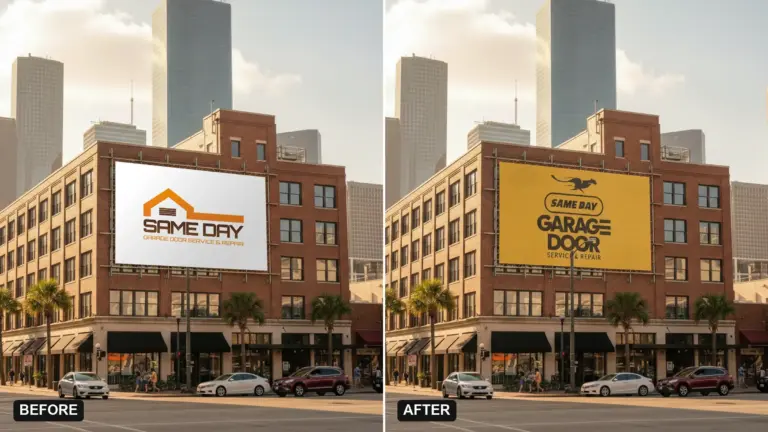
A client who struggles to picture a storefront, a package or a space can see a conceptual visualization early on. Instead of debating "premium but warm," we look at options and refine. Every such image is labeled as a concept, and real logos or copy are composited from the original source files.
Production volume
A brand lives across social, web, email and decks. Smart tools speed up format adaptations; the system thinking stays human.
Things that weren't feasible before
One example from our own work is WEST ALABAMA, a video created entirely with AI from architectural renderings. Without these tools, a project that hasn't been built yet would have been presented in stills, or in far more expensive CGI animation. That is a multiplier in the full sense: the same creative thinking, with an execution range that didn't exist before.
What AI can't do
Honesty matters here:
- It doesn't know what your business needs. It wasn't in the discovery session, hasn't heard your customers and doesn't know your competitors on the ground.
- It drifts toward the average. Generative models learn from what already exists, so they readily reproduce what's common. Differentiation requires the opposite.
- It takes no responsibility. If it invents a fact, distorts a logo or produces something too close to existing work, someone has to catch it before it reaches the client.
- It doesn't edit itself. Good creative work means cutting, reducing and saying no to a beautiful idea that doesn't serve the goal. The tool will always offer more.
- It lacks deep cultural context. A color, gesture or word can work in one market and misfire in another. Getting that right takes human knowledge and sensitivity.
So what does a designer do now?
The role hasn't disappeared; it has shifted. Less time goes into repetitive execution, and more goes into three things:
- Framing the right question. A sharp brief is half the work. People who can define what they're looking for get better results from the tools.
- Judgment and selection. Choosing, from dozens of options, the one that fits the business, the audience and the message — and being able to explain why.
- Building and refining. Logos, typography, grids and visual systems are built by hand, with attention to what machines miss: optical balance, legibility at small sizes, consistency across touchpoints.
Running that process well requires understanding both design and technology. At Karnaf Studio, that combination is part of how we're built: owner Chen-Haim Bachar holds degrees in computer science and in visual communication, and is a senior lecturer at Avni College.
Example: same tool, two outcomes
Imagine two neighborhood cafés that each want a new visual identity. The first owner opens an AI tool, asks for "a logo for a cozy café," and gets dozens of steaming cups and coffee beans. They all look fine, and they all look like every other café.
The second owner goes through a branding process. Discovery reveals that what makes the place special is its tie to an old neighborhood and a long-serving baker. A completely different direction follows from that insight — and this is where AI earns its place: quickly testing textures, an old-bakery palette and photography styles, then visualizing the language on a sign, a bag and a cup. Same tool, but this time it multiplies a real idea. (This is an illustrative scenario, not a description of a specific client project.)
Pros and limitations
| What AI multiplies | What stays human |
|---|---|
| Number of directions you can test | Deciding which direction is right |
| Speed of visualizing for the client | Understanding the client, audience and market |
| Production volume and format adaptations | Building the logo and visual system |
| Access to styles and visual techniques | Taste, editing and knowing what to drop |
The key limitation: the more AI is used without a process, the more results start to look alike. The competitive edge moves from people who can operate the tools to people who know what to ask for — and what to throw away.
FAQ
Can AI be creative on its own? It can produce surprising combinations, and sometimes they're genuinely inspiring. But creativity in a business sense is an original solution to a defined problem — and that requires understanding the problem, judgment and accountability.
If AI saves time, why isn't creative work always cheaper? Because most of the value in branding lies in thinking, discovery and precision, and those don't shrink. What usually improves is the depth of exploration and visualization within the same scope.
How can I tell if a studio uses AI well? Ask which stages they use it in and which they don't, who builds the logo, and how visualizations are labeled. Specific, transparent answers are a good sign.
In summary
AI and creativity aren't competitors. AI multiplies what's there: sharp thinking becomes a richer, faster result, and fuzzy thinking becomes noise. So the real question isn't whether to use AI, but who's steering. Karnaf Studio, active since 2003, combines more than 20 years of branding experience with AI tools so that good ideas travel further.
Want a brand that starts with a sharp idea and uses technology to go further? See our branding portfolio or talk to us.
Let’s talk about your brand
Tell us about your project and we’ll get back to you.
Contact Karnaf Studio