

✦Summary
Cosmetic packaging design is one of the most demanding briefs in design. The pack has to sell on a crowded shelf, signal quality at first touch, carry the labelling a regulator requires, and still read clearly as a thumbnail in an online store. AI tools are changing the research and visualisation stages, but not what decides whether a pack works. This guide walks through the packaging process for cosmetics and hair care, where AI genuinely helps, and where you still need a trained eye and original artwork files.
A young beauty brand is planning its first line: shampoo, conditioner, mask and serum. The formulas are ready, the supplier has shared a bottle catalogue, and the founder has already generated a few AI images of her "dream packaging". They look beautiful. Then the real work starts. The bottle in the images doesn't exist at any supplier, the label leaves no room for the ingredient list, and from a metre away nobody can tell the shampoo from the conditioner.
That is the gap between inspiration and cosmetic packaging design. AI is excellent at inspiration. Good packaging also needs decisions about structure, material, hierarchy and regulation.
Karnaf Studio, active since 2003, designs brands and packaging and uses AI in research, concept and visualisation. Here is how that works in practice.
What makes cosmetic packaging work
- Fast shelf recognition. Shoppers scan a shelf in seconds. Colour, shape and structure have to stop them.
- Instant product understanding. What it is, who it's for and how it differs from the product next to it.
- Perceived quality. Material, weight, finish and closure shape expectations before the product is even used.
- Range consistency. Every SKU should feel like the brand while remaining clearly distinct.
- Room for mandatory information. Ingredients, directions, warnings and responsible-person details, depending on the market.
- Digital performance. If it can't be read at thumbnail size, it effectively doesn't exist online.
Where AI fits into the packaging process
1. Shelf and competitor research
AI helps map a category's visual language quickly: recurring colours, bottle shapes, typographic styles. In professional hair care, for instance, you may find that most brands default to black and metallics, which is exactly where an opportunity for contrast lies. Every finding is checked by a person, because AI tools can get facts and brands wrong.
2. Mood and material directions
AI works as a fast moodboard: frosted glass versus matte plastic, wooden cap versus brushed metal, earthy tones versus pastels. Clients see tangible directions early and decide based on images rather than descriptions.
3. Structure: choosing against reality
This is where AI stops. Bottles, tubes, jars and pumps are chosen from what suppliers actually manufacture, or engineered as custom tooling when budget and volumes justify it. We design on the supplier's technical drawing, because every label depends on those dimensions.
4. Label design and hierarchy
This is the core of the job and it is done by designers: brand name, product name, hair or skin type, the key promise, a colour system for variants, and planned space for mandatory copy. Bilingual labels add another challenge. In Israel, for example, Hebrew runs right-to-left alongside Latin text, and both must work without clashing.
5. Visualisation and compositing
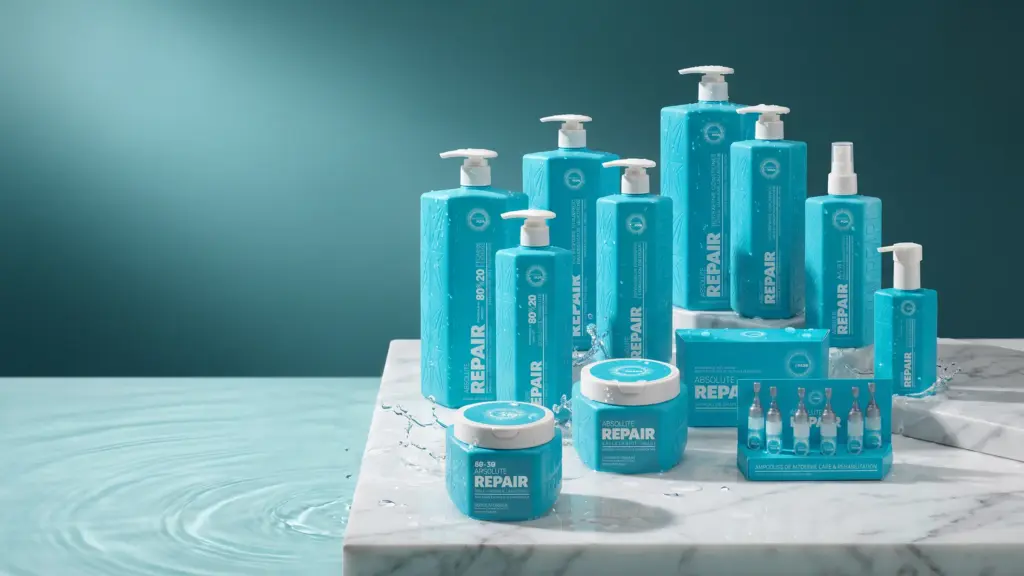
Once the label is approved, AI is great at scenes: stone, water, fabric, soft light. But we never ask a model to draw the label. Generative models distort letters and logos, so we generate the scene with a blank, unbranded bottle and composite the original label artwork onto it. Every letter, colour and spacing stays identical to the approved file.
6. Print preparation
Dielines, bleeds, spot colours where needed, and adaptation to the printing method. A render on screen is no substitute for a physical proof: ink on plastic, glass or metallic stock looks different from a monitor.
Labelling and regulation: who owns what
Cosmetic packaging is also a compliance document. In the EU, Article 19 of Regulation (EC) No 1223/2009 requires the container and packaging to show, among other things, the name and address of the responsible person, the batch number, particular precautions for use, the product's function where it isn't clear from its presentation, and a list of ingredients. Other markets have their own rules. In Israel, for example, cosmetics are governed by the Pharmacists Regulations (Cosmetics), 2023, overseen by the Ministry of Health's cosmetics department.
The right split: the manufacturer, importer or regulatory consultant decides what must appear. The designer decides how it appears, legible, organised and integrated into the brand instead of looking like an afterthought sticker. Get the full labelling list at the start of the project, not after the design is signed off.
This is general information, not legal or regulatory advice. Confirm mandatory labelling with the relevant regulator or a regulatory consultant.
Common mistakes
- Variants that look identical. If only one small line of text changes, customers grab the wrong one.
- Ignoring the container. A label designed flat that looks completely different on an oval bottle.
- Mandatory copy squeezed in at the end. It becomes a tiny block that hurts both legibility and aesthetics.
- Renders that overpromise. Finishes or colours production can't achieve.
- Packs that only work in person. Impressive on shelf, a blur as an online thumbnail.
What to prepare before you start
- The product list, with sizes and volumes
- Supplier catalogues or technical drawings for bottles and closures
- Mandatory labelling requirements for each target market
- Brand guidelines and logo source files, if they exist
- Target retail price and channels (salons, retail chains, online)
- Competitor packs you admire, and ones you don't want to resemble
Pros and limitations
| What AI adds | What still needs professional work |
|---|---|
| Broad, fast shelf research | Verifying findings |
| Early, tangible mood and material directions | Choosing a manufacturable container |
| Scenes for e-commerce and campaigns | Accurate labels from source files |
| Quick channel variants | Physical colour proofs and print prep |
FAQ
Can we design the pack before choosing a bottle? You can start with a visual direction, but the label itself must be built on a real container and real dimensions. Choose early.
Can renders go on our online store before launch? Yes, as long as they faithfully represent what customers will receive: same container, same colour, same label.
In summary
Cosmetic and hair care packaging design now blends AI's ability to explore and stage scenes with the precision of designers who build hierarchy, respect regulation and apply labels from original files.
Planning a cosmetics or hair care line? See our branding portfolio or talk to us.
Note: The hero image is a conceptual AI-generated visual created for this article and is not a client product.
Sources
- Regulation (EC) No 1223/2009 on cosmetic products, Article 19 (Labelling), EUR-Lex – https://eur-lex.europa.eu/eli/reg/2009/1223/oj/eng
- Israel Ministry of Health, Pharmacists Regulations (Cosmetics), 2023 (Hebrew) – https://www.gov.il/he/pages/rokhut33a
Let’s talk about your brand
Tell us about your project and we’ll get back to you.
Contact Karnaf Studio