



✦Summary
A rebrand is one of the riskiest decisions a business makes. The old identity no longer reflects who you are, yet it carries recognition, loyal customers and visual memory you can't afford to throw away. AI tools now make it faster to explore refresh directions, preview the new identity on real touchpoints and map everything that has to be replaced. This article explains what AI really changes in a rebranding process, what it leaves untouched, and how to decide without losing what already works.
The signs are familiar to any established company. The logo was designed many years ago, the website looks dated next to newer competitors, and the audience has shifted. Maybe you've grown from a local service into a national or international player, maybe you've launched a new product line, or maybe the brand simply stopped feeling like you. The first question is almost always the same: do we need a full rebrand, or just a brand refresh?
Lately, a second question has joined it. If AI image generators can produce dozens of logos in a minute, why not do an AI rebranding in-house? At Karnaf Studio, active since 2003, we've integrated AI into our branding workflow. Experience has taught us that AI changes a great deal about how a rebrand happens, and very little about the decisions that matter.
Brand refresh vs. full rebrand
Before talking about tools, define the type of change. That distinction sets the scope, the risk and the role AI can play.
| Brand refresh | Full rebrand | |
|---|---|---|
| What changes | Logo update, colors, typography, applications | Positioning, messaging, sometimes the name, a new visual language |
| What stays | Core identity and visual memory | Mostly reputation and customer relationships |
| When it fits | The brand is right but looks dated | The business has fundamentally changed, or the current brand holds it back |
| Main risk | A cosmetic change that doesn't solve the real problem | Losing recognition among existing customers |
The classic mistake is jumping straight into design. A new logo won't fix a positioning problem, and that's exactly where an image generator can't help: it can produce shapes, but it can't decide what your business should stand for.
Where AI genuinely helps in a rebrand
1. Auditing the existing brand
Established businesses accumulate dozens of brand touchpoints over the years: business cards, signage, decks, document templates, email signatures, vehicles, packaging, social profiles. AI tools help sort and catalog that material, flag inconsistencies (three slightly different versions of "the same" navy, for example) and build a complete touchpoint inventory. That inventory usually reveals how far the brand has drifted.
2. Re-reading the market
A brand designed ten years ago was designed for that market. AI speeds up current competitor research: which colors and styles dominate the category today, how new entrants present themselves, what customers say in reviews. As with any research, every finding is checked by a person, because models can invent data or mix up brands.
3. Exploring refresh directions
This is where AI adds real value. Instead of presenting two or three locked concepts, you can explore a wider range of color, texture and mood options earlier. A question like "what if we keep the symbol and only change the palette?" gets a visual answer instead of a verbal one.
4. Testing on real applications before deciding
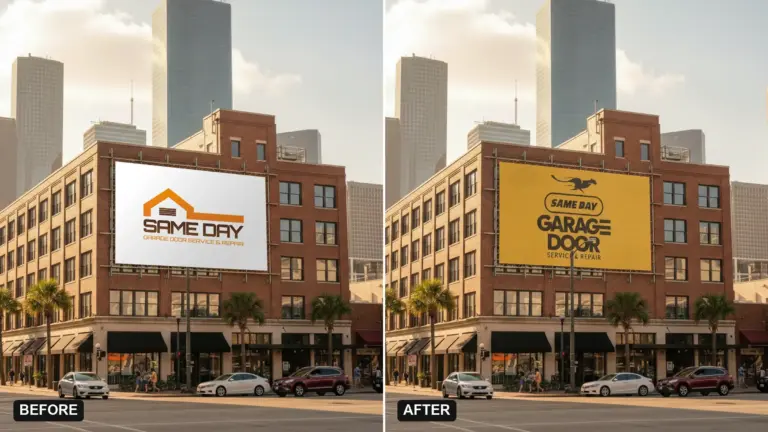
The biggest fear in rebranding is discovering too late that the new identity fails on the storefront, the packaging or a small screen. Mockups let you see the new system "live" on a building, a vehicle or a social post before investing in production. In our process every such mockup is labeled as a conceptual visualization, and the actual logo and text are composited in from source files, because generative models tend to distort lettering.
5. Planning the rollout
Rebrands often fail not in design but in transition: half the materials get updated, half stay old, and customers meet two brands at once. AI helps build a structured replacement plan, prepare templates and draft copy in the new tone of voice for every channel.
What AI doesn't change
- Deciding what to keep. Every mature brand has equities customers recognize: a color, a shape, the sound of a name. Choosing which ones to preserve is a strategic call that requires knowing the business and its customers.
- The reason for change. "We're bored with the logo" is not a brief. A good rebrand starts from a clear business problem: a new audience, a new market, positioning that no longer works.
- Building the mark itself. We draw the new logo by hand: sketches, grid, typography, legibility tests at small sizes. There's a legal reason too, covered below.
- Telling your customers. Explaining to existing customers what changed, and why, is part of the rebrand, not an afterthought.
Common rebranding mistakes
- Throwing everything out. Changing name, symbol and colors at once can lose customers who simply no longer recognize you.
- Changing only the logo. If the website, signage and decks stay old, the change looks like an error rather than a renewal.
- Deciding by personal taste. The brand serves the audience, not the boardroom.
- Chasing a trend. AI tends to reproduce what's already common, so it's easy to land on a look that feels current today and dated in two years.
- Skipping the guidelines. Without written rules, the new identity will fragment as quickly as the old one did.
Pros and limitations
Pros: faster, more complete brand audits; more directions explored early; seeing the new identity on applications before production; a more orderly rollout.
Limitations: AI doesn't know your history or how customers feel about your brand; generative output drifts toward the visual average; logos and letters get distorted in mockups, so source-file compositing is required; and there are copyright questions around marks created entirely by a machine.
On copyright: According to the U.S. Copyright Office report published in January 2025, material generated by AI without sufficient human creative contribution is not protected by copyright. When a new logo is meant to carry a company for years, that matters. (This is general information, not legal advice. For trademark registration, consult an IP attorney in your jurisdiction.)
FAQ
How do I know whether I need a rebrand or a refresh? If your positioning and message are still right and only the look feels dated, a refresh is usually enough. If you've changed audience, category or promise, consider a full rebrand.
Can we rebrand using only AI tools? You can generate lots of ideas with them. But deciding what to keep, what to change and how to roll it out takes strategy, a trained eye and accountability for the result.
Will existing customers be confused? That depends mostly on planning. Preserving one or two recognizable assets and communicating clearly around launch greatly reduces the risk.
In summary
AI has turned rebranding into a process where you see more, test more and decide with more information. It hasn't made it simple. The important calls, what to keep, what to change and why, remain human decisions grounded in knowledge of the business. Karnaf Studio combines more than 20 years of branding experience with AI tools to refresh brands without losing what they've built.
Considering a rebrand? See our branding portfolio or talk to us.
Sources
- U.S. Copyright Office, Copyright and Artificial Intelligence, Part 2: Copyrightability, January 2025 – https://www.copyright.gov/ai/
Let’s talk about your brand
Tell us about your project and we’ll get back to you.
Contact Karnaf Studio