

✦Summary
A corporate video is still one of the strongest ways to present a business, but the way it's produced has changed. AI tools now make it possible to create scenes that once required a location, a crew and equipment, to visualize ideas before shooting, and to produce versions for every channel. This article explains what AI corporate video production looks like, when it fits and when real footage is better, and what to demand from whoever produces it for you.
Many business owners keep postponing their brand video. Sometimes it's budget, sometimes uncertainty ("what would we even film?"), and sometimes the business doesn't fully exist yet: the project is under construction, the product is in development, or the service simply doesn't "film well." Meanwhile, competitors show up in the feed with video, and the website stays with text and photos.
AI doesn't solve all of that, but it opens possibilities that didn't exist a few years ago. Karnaf Studio has produced corporate videos, animation and commercials for many years, and today AI is part of our toolkit. In our video gallery you can see, for example, WEST ALABAMA — a video created entirely with AI from architectural renderings — and WELCOME TO GREENFIELDS, an AI video.
What AI makes possible in a corporate video
Showing what doesn't exist yet
A real estate project before construction, a product before manufacturing, a company's vision. These used to be visualized only through expensive CGI animation. Now renderings, plans and ideas can be turned into cinematic video scenes.
Testing an idea before investing in it
Instead of handing a client a written script and asking them to "imagine it," you can build an illustrated storyboard or animatic: a rough version of the video showing pacing, mood and structure. Decisions are made earlier, and fixes during shooting and editing shrink.
Extending real footage
You can film a manager or team in the studio and place them in a different environment, extend the frame, change the sky or season, or add elements that are hard or costly to shoot.
Producing versions for every channel
One corporate video now has to live on the website (16:9), on social (9:16 and 1:1), in presentations and in paid campaigns. Smart tools speed up adaptation, subtitles and cut-downs.
What the production process looks like
1. Definition and message
What should the video achieve? Who's watching, and where? Technology doesn't change this stage, and it determines everything else. A video that starts from technology rather than message ends up impressive and empty.
2. Concept and script
Story, voice-over and structure. We use AI to explore variations in phrasing and structure, but the script is written and edited by someone who knows the brand and the audience.
3. Illustrated storyboard
This is where AI adds the most value: each scene gets a representative frame defining mood, palette, lighting and composition. The client sees the video before it exists.
4. Production: live action, AI or both
For each scene we choose the right tool: – Live action: for real people, testimonials, work in the field, physical products and moments that demand credibility. – AI generation: for environments, vision, explanations, transitions and scenes that can't be filmed. – Hybrid: live footage with an AI-generated extension or environment.
5. Editing, color and sound
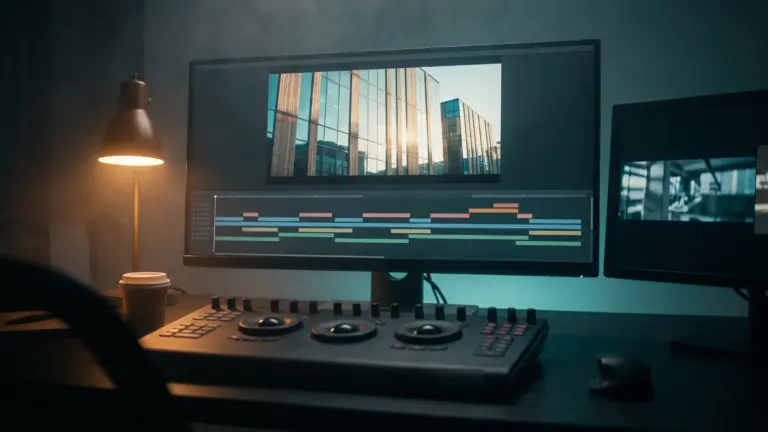
This stage turns a collection of scenes into a film: pacing, music, voice-over, color correction and visual consistency between filmed and AI-generated material. It decides whether the video looks professional or "assembled from parts."
6. Versions and distribution
A full version for the website, short cuts for social, subtitles (important, since many people watch without sound) and a thumbnail.
When AI fits — and when it doesn't
| AI is a strong fit | Real footage is better |
|---|---|
| Projects not yet built | Customer testimonials and real people |
| Illustrating an idea, vision or process | Showing your place, team and product as they are |
| Locations that are hard or costly to reach | Sectors where trust is everything (healthcare, finance) |
| Many campaign variations | Scenes where subtle emotional nuance matters |
Rule of thumb: anything a viewer might take as reality should either be real or clearly labeled as illustration. An office that doesn't exist, customers who don't exist or results that weren't achieved don't belong in a corporate video, even if the technology makes them possible.
What to watch for
- Consistency: people, products and logos need to look the same from scene to scene. Video models still struggle with this, and professional work is needed to maintain continuity.
- Logos and text: as with images, logos and on-screen text are added in post-production from source files — never "drawn" by the model.
- Rights: music, voice-over, voices and characters need clear licensing. Never use a real person's likeness or voice without consent.
- Transparency: when something in the video is an illustration, we recommend saying so.
What to prepare before the kickoff meeting
- One clear goal: customer acquisition, recruitment, product launch or investor pitch. A video that tries to do everything achieves nothing.
- Target audience: who needs to watch, and what should they do afterward?
- Existing assets: brand book, logo source files, photos, renderings, decks and previous videos.
- What's real and what's future: what exists and can be filmed, and what's still planned and needs visualizing?
- Distribution channels: website, YouTube, social, trade shows, presentations — they affect length, aspect ratios and subtitles.
- References you like: even from other industries. They help define tone and pace.
FAQ
How long does AI corporate video production take? It depends on length, complexity and how much live footage is involved. AI mainly shortens visualization and versioning. Definition, scripting and editing still take their time.
Can a corporate video be made with no filming at all? Yes — WEST ALABAMA is an example. It suits projects presenting a vision or something that doesn't exist yet. When the goal is building trust in people and a business, combining real footage is almost always worthwhile.
Do AI videos look "fake"? A video built without planning, consistency and professional editing can. One that's planned properly, with a deliberate decision about where AI goes and where cameras go, looks like any professional production.
In summary
AI hasn't made corporate video simple, but it has made it more accessible and flexible. You can show what doesn't exist yet, see the video before producing it and adapt it to every channel. The real value still lies in the message, the script and the edit. Karnaf Studio, active since 2003, combines long experience in corporate video, animation and commercials with advanced AI tools, choosing the right tool for every scene.
Want a video that tells your story? Watch our video gallery or talk to us.
Let’s talk about your brand
Tell us about your project and we’ll get back to you.
Contact Karnaf Studio